
A New Era of Strategic Marketing
Marketing strategy is undergoing a radical transformation, moving from manual planning to machine-generated precision.
Imagine the owner of a boutique winery in South Australia’s Barossa Valley, standing amid sun-drenched rows of eco-certified Shiraz vines. Instead of huddling in a late-night brainstorming session to map out the next quarter’s growth, they sip a glass of their own wine and review a document on their tablet. It’s a comprehensive marketing plan, complete with market analysis, audience segmentation, budget allocation, ROI projections, and innovative campaign concepts, all generated in minutes.
This isn’t science fiction. It’s the reality of strategic marketing, driven by the convergence of data analytics, machine learning, deep learning, and Large Language Models (LLMs). For decades, marketing has blended art and science, relying on human intuition, creativity, and labour-intensive data analysis. But the science is shifting dramatically. The next breakthrough marketing plan won’t be born in a boardroom, it will be engineered by an algorithm.
This article explores how AI has evolved from a basic tool into a strategic collaborator – and why embracing this machine-driven approach is becoming a critical competitive edge.
From Calculation to Cognition
The Rise of the Machine Strategist
The story of artificial intelligence began in 1956 with a hopeful gathering of scientists, unfolding through gradual progress and explosive breakthroughs. Early AI excelled at narrow, repetitive tasks but lacked the depth for nuanced understanding or creative synthesis. The journey to today hinges on three pivotal advancements.
- Machine Learning (ML)
Enabled computers to learn from data without explicit programming, allowing systems to detect patterns, classify information, and make predictions. This laid the foundation for intelligent automation. - Deep Learning
A subset of ML, deep learning uses multilayered neural networks to uncover subtle, nonlinear patterns in vast datasets. While a human might spot a seasonal sales trend, a deep learning model could reveal correlations between weather patterns, social media sentiment, and purchasing behavior for specific demographics. - Large Language Models (LLMs)
Act as an intuitive interface, bridging deep learning’s analytical power with human strategy. LLMs enable users to issue complex commands, ask nuanced questions, and receive coherent, structured responses.
Together, these technologies have transformed AI into a cognitive partner. For our Barossa Valley winery, navigating inventory surpluses and a $2.48 billion surge in export value, this machine intelligence is not just a tool but an expert collaborator.
The AI Strategist at Work
Crafting a Data-Driven Masterplan
To illustrate this evolution, let’s follow the journey of an AI-powered strategic planner tasked with a complex challenge for our winery, operating in a dynamic Australian wine market. Export value grew 13% to $2.48 billion by June 2025, driven by demand from China, though U.S. sales dropped 12%. Consumers increasingly favour premium, eco-friendly wines. The winery’s internal sales data offers a treasure trove of insights to shape a targeted strategy.
Query for AI Strategist
“Develop a marketing plan for our eco-certified wine targeting young urban professionals in key domestic markets, while analysing sales performance among young international customers to project future potential and inform the strategy, leveraging current market trends and our internal sales data.”
Step 1
Understanding the Goal and Data
The AI strategist begins by interpreting the query, breaking it into two interwoven goals, crafting a domestic marketing plan for young urban professionals and analysing international sales data to uncover trends and projections. It accesses the winery’s wine_sales dataset
| ID | Region | Vintage | Sales | Age | Country | Eco |
| 1 | Barossa Valley | 2023 | 25000.00 | 28 | USA | 1 |
| 2 | Margaret River | 2024 | 18000.00 | 35 | UK | 0 |
| 3 | Barossa Valley | 2023 | 32000.00 | 24 | China | 1 |
| 4 | McLaren Vale | 2024 | 22000.00 | 30 | USA | 0 |
| 5 | Barossa Valley | 2025 | 28000.00 | 27 | Australia | 1 |
| 6 | Barossa Valley | 2024 | 35000.00 | 31 | China | 1 |
The strategist employs a team of specialised AI agents-data analysts, market researchers, financial modelers, creative designers, and risk assessors coordinated by an orchestrator agent. This collaborative network ensures every angle of the query is addressed with precision.
Step 2
Analysing Sales for Strategic Insights
The data analysis agent dives into the wine_sales dataset to evaluate eco-certified wine performance among young international customers (age < 35, non-Australian markets). It constructs a sophisticated SQL query, incorporating the 13% market growth trend
— Identify high-performing regions for young, eco-conscious export markets.
— Exclude domestic sales, focus on significant transactions, and project growth.
SELECT
Region,
AVG(Sales) AS AverageSale,
COUNT(*) AS NumberOfTransactions,
SUM(Sales) * 1.13 AS Projected_2026_Value
FROM wine_sales
WHERE Age < 35 AND Country != ‘Australia’ AND Eco = 1
GROUP BY Region
HAVING AverageSale > 20000;
- Filtered Rows: IDs 1, 3, 6 (Sales: 25,000; 32,000; 35,000; all Barossa Valley, eco-certified, young buyers, international markets).
- Results:
- Average Sale: $30,666.67
- Transactions: 3
- Current Total: $92,000
- Projected 2026 Value (with 13% growth): $103,960
Insight
Barossa Valley’s eco-certified wines are a hit with young international buyers, particularly in China and the U.S., driving significant sales. This suggests a strong brand appeal that can be mirrored domestically.
The market research agent complements this by scanning external data, noting the 13% export growth and rising demand for eco-friendly products. It identifies a “Sustainable Hedonist” segment among young urban professionals (aged 26-34) in domestic markets like Sydney and Melbourne, who prioritise sustainability and engage heavily on TikTok and LinkedIn.
Step 3
Crafting the Marketing Plan
With data insights in hand, the orchestrator agent directs the team to build a tailored marketing plan for domestic young urban professionals, informed by international success. The creative agent proposes positioning the wine as a symbol of sustainable luxury, while the financial modeling agent optimises budget allocation. The risk assessment agent flags potential drought-related supply chain issues, suggesting proactive messaging.
The Plan Summary
- Executive Summary
Capitalise on the eco-certified wine’s international success to position it as a premium, sustainable choice for domestic urban professionals, aiming for a 15% sales increase within 12 months while mitigating risks from U.S. market declines.
- Audience
Target 26-34-year-old “Sustainable Hedonists” in Sydney and Melbourne, who value transparent sustainability and engage on TikTok (lifestyle) and LinkedIn (professional networking).
- Strategic Focus
Frame the wine as an emblem of a conscious, luxurious lifestyle.
- Campaigns & Channels
- Meta, YouTube & TikTok ($25,000) – Launch a “Vine to Glass” video series showcasing eco-friendly processes via partnerships with 3–5 micro-influencers in Sydney and Melbourne.
- LinkedIn ($10,000) – Target B-Corp professionals with sponsored posts on sustainable corporate entertaining.
- SEO/Content – Publish 5–7 optimised blog posts on “Australia’s Best Sustainable Wines” to capture search traffic.
- Risk Mitigation
Address potential drought disruptions with messaging on water conservation efforts.
Step 4
The Architecture Behind the Strategy
This plan emerges from a symphony of AI agents working in a continuous loop
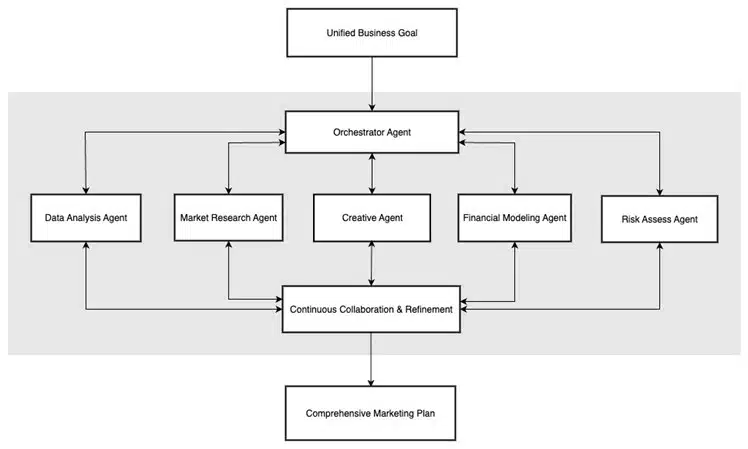
- Orchestrator Agent – Parses the query and assigns tasks.
- Data Analysis Agent – Queries internal sales data for trends.
- Market Research Agent – Gathers external market insights.
- Financial Modelling Agent – Projects ROI and budgets.
- Creative Agent – Designs campaign messaging.
- Risk Assessment Agent – Identifies supply chain risks.
This collaborative architecture ensures the strategy is data-driven, creative, and forward-looking, transforming raw data into a polished plan in minutes.
The Future Is Authored by Algorithms
Why will machines author the next marketing plan? They process vast datasets at unmatched speed, detect imperceptible patterns without bias, and, through LLMs, deliver clear, creative strategies. For our winery, the AI strategist not only analysed international sales to uncover Barossa Valley’s strength but also crafted a domestic campaign that leverages those insights, all while anticipating risks.
Your New Role
This shift doesn’t sideline leaders, it elevates them. Freed from data drudgery, you become the conductor of an AI orchestra, setting visions and guiding the system with human intuition. The brands that dominate the next decade will master this human-machine partnership. The future isn’t just harvested in vineyards; it’s engineered by algorithms. It’s time to unleash your new strategist.